
Aankondiging
en uitleg van dit werk door Ton Hartsuiker in het programma 'Musica Nova'
Indien deze opnames het niet doen, - zie hieronder;
If this recording doesn't work, - see here below;
Voor de Audio-voorbeelden van de andere
delen, zie hieronder /
for the Audio examples of the other parts, see here below
Suite
voor 12 dwarsfluiten
opus 8
(1982-84)
[ca. 30 min.]
Donemus
___________________________
Toelichtingen
Het gaat om 5
verschillende stukken in (5) verschillende technieken,
waaronder een werk met alle
12 de toonklokuren van Peter Schat,
een minimal-music-stuk, een stuk met
Ligetiaanse mikropolyfonie, een lyrisch stuk etc.
In die tijd componeerde de componist (nog) in de 12-toonstechniek.
1/ 12-stemmige 12 toons-canon / Andante
2/ Scherzo
3/ De 12 uren van de toonklok van Peter Schat
4/ Intermezzo
5/ Aleatorische Minimalmusic volgens een twaalftoonsreeks
Dit werk is in 1984 en 1986
uitgevoerd ensembles van het Utrechts en Hilversums conservatorium
en in 1991 en 1992 door fluitensemble
TUTTI FLUTTI.
Voor nadere toelichtingen, zie hieronder.
___________________________________________
Explanations
It concerns 5 different pieces in
(5) different techniques,
including a work with all 12 tone clock hours by Peter Schat,
a minimal music piece, a piece with Ligetian micropolyphony, a lyrical piece,
etc.
At that time, the composer (still) composed in the 12-tone technique.
1/ 12-part 12-tone canon / Andante
2/ Scherzo
3/ The 12 hours of Peter Schat's tone clock
4/ Intermezzo
5/ Aleatoric Minimal music according to a twelve-tone series
This work was performed in 1984 and 1986 by ensembles of the Utrecht and
Hilversum Conservatory
and in 1991 and 1992 by flute ensemble TUTTI FLUTTI.
For further explanations, see below.
Aankondiging van het concert met de première:
Het programma van de première:

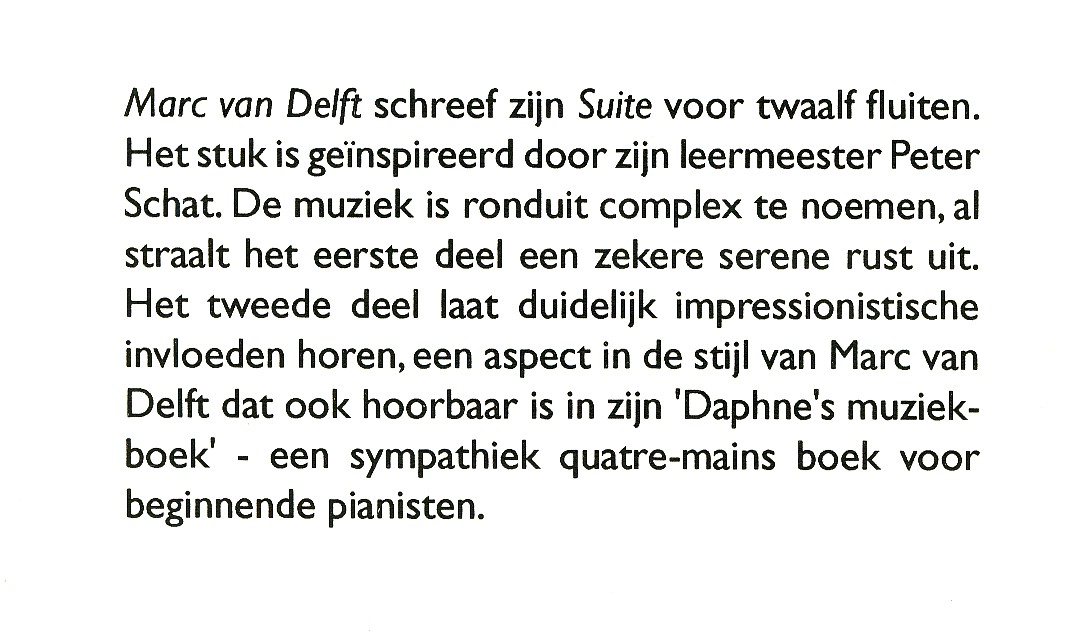
Toelichting uit programmaboekje:
DEEL 3 / PART 3
Opname van deel 3, -de
toonklok:
Recording of part 3, -the tone clock:
(Aankondiging
en uitleg van dit werk door Ton Hartsuiker in het programma 'Musica Nova')
____________________________________________________________________________________
Toelichtingen
Peter Schat, de compositieleraar van Marc van Delft (van 1977-1982), ontdekte
dat het mogelijk was om van de 12 mogelijke drieklanken ook 12-toonsreeksen te
maken van 4x 3 groepjes noten. (uitgezonderd, het 10e uur, de stapeling van
kleine tertsen, dat werden 3 groepjes van 4 noten: verminderde septiem-akkoorden)
.
In dit werk van Marc van Delft passeren alle 'toonklokuren' de revue, het begint
met de kleinste drieklank (1e uur) en eindigt met de grootste drieklank (12e
uur).
Het 1e uur is de drieklank van kleine secundes, bv. C-Cis-D, en de grootste, het
12e uur is de drieklank van grote tertsen, de overmatige drieklank, bv. C-E-Gis.
Het stuk begint verstild en werkt naar een climax toe in het dramatisch
dissonante 5e uur [C-Des-Ges bv.).
Met het 6e uur (2 grote secundes) begint het opnieuw verstild en bouwt dan weer
een climax op naar de overmatige drieklanken van het 12e uur wat eindigt in een
uitbundige apotheose.
Explanations
Peter Schat, Marc van Delft's composition teacher (from 1977-1982), discovered
that it was possible to make 12-tone series of 4x 3 groups of notes from the 12
possible triads. (with the exception of the 10th hour, the stacking of minor
thirds, which became 3 groups of 4 notes: diminished seventh chords).
In this work by Marc van Delft all 'tone clock hours' are reviewed, it starts
with the smallest triad (1st hour) and ends with the largest triad (12th hour).
The 1st hour is the triad of minor seconds, e.g. C-C sharp-D, and the largest,
the 12th hour, is the triad of major thirds, the augmented triad: C-E-G-sharp.
The piece starts quietly and builds to a climax in the dramatically dissonant
5th hour [C-Des-Ges).
With the 6th hour (2 major seconds) it starts again quietly and then builds up
to the augmented triads of the 12th hour, ending in an exuberant apotheosis.
zie ook:
https://duodenum.home.xs4all.nl/triosonic/docs/toonklok-n.html
Een recensie in het Parool van het concert in Utrecht:


________________________________________
Het deel 'de toonklok' was tot 2024 het enige deel
wat op de website stond, want dat was een professionele radio opname, de andere
delen (1, 2 en 4, 5) zijn speciaal voor het fluit-ensemble 'Tutti Flutti' in
2024 ook op de website gezet omdat deze (na 33 jaar...) opnieuw interesse hadden
in dit werk, zodat ze een indruk van de muziek konden krijgen. De opnames zijn
ontleend aan hele oude cassettebanden die helaas van veel mindere
geluidskwaliteit zijn, en door de tand des tijds zijn aangetast....
The part 'the tone clock' was the only part that was on the website until
2024, because it was a professional radio recording, the other parts (1, 2 and
4, 5) were also put on the website, especially for the flute ensemble 'Tutti
Flutti' in 2024 because (after 33 years...) they were interested again in this
work, so that they could get an impression of the music. The recordings are
taken from very old cassette tapes that unfortunately have much poorer sound
quality and have been damaged by the ravages of time....
DEEL 1 & 2 / PART 1 & 2
Op 28 juni 1985 werd het werk ook nog op het eindconcert door
een van de ensembles van de
Muziekpedagogische Akademie Hilversum o.l.v.
Jurriaan Röntgen uitgevoerd (het Andante en het scherzo).
(die middag ervoor bezocht ik Tristan Keuris, van wie ik dat jaar
compositieles had gehad, en die in Hilversum woonde)
Het was vlak voor de zomervakantie...
-----------------------------------------------------------
Toelichtingen /
Explanations:
De canon is beïnvloed door de Ligetiaanse micropolyfonie, zoals in 'Lontano'.
The canon is influenced by Ligetian micropolyphony, as in 'Lontano'.
In het scherzo zie je ook duidelijk invloed van bv. 'de dans van de
vuurvogel' van Strawinsky,
of Respighi's 'Pini di Roma'.
In the scherzo you also clearly see
the influence of, for example, 'the dance of the firebird' by Stravinsky,
or Respighi's 'Pini di Roma'.
----------------------------------------
OPNAMES /
RECORDINGS:
-------------------------------------------
Excuses voor de slechte kwaliteit van de opnames, maar deze mp3's zijn in
2024 gemaakt van hele oude cassettebanden uit 1986, dus 38 jaar oud!
Het is dus alleen maar om een indruk te krijgen van deze stukken.
Apologies for the poor quality of the
recordings, but these MP3s were made in 2024 from very old cassette tapes
from 1986, so 38 years old!
So it's just to get an impression of these pieces.
In 1991 werden dezelfde delen 1 en 2 werk ook uitgevoerd door 'Tutti Flutti':

_____________________________________________________________________________________________
De 2 delen: Canon en Scherzo, speelde Tutti Flutti op
17-11-1991.
Dat was een concert waar de componist helaas zelf niet bij kon zijn omdat hij op
die dag een andere uitvoering had....
The 2 parts: Canon and Scherzo, Tutti
Flutti played on 17-11-1991.
That was a concert that the composer himself could not attend because he had
another performance on that day....
_________________________________________________________
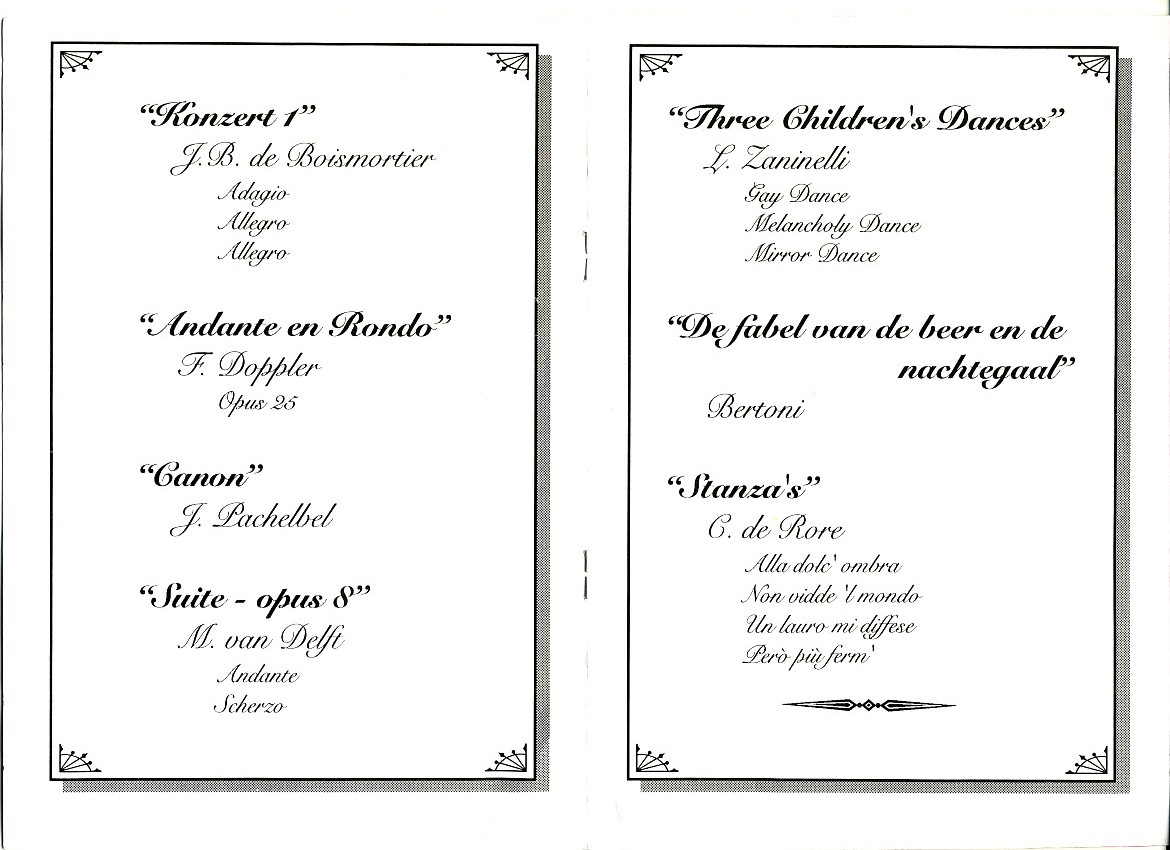
Het concertprogramma van Tutti Flutti:
---------------------------------------
OPNAMES /
RECORDINGS:
-------------------------------------------
Tutti Flutti heeft daar een wat betere opname van gemaakt als
de opname van het concert in Hilversum,
het was dus een opname / cassetteband van Tutti Flutti.
Helaas is de opname van het begin van het scherzo ook door de tand des tijds
aangetast,
met bibber-geluiden, maar later klinkt het beter....
Ook deze cassetteband is oud, 33 jaar oud....
Tutti Flutti made a better recording of their concert than the recording of the
concert in Hilversum,
so it was a recording / cassette tape of Tutti Flutti.
Unfortunately, the recording of the beginning of the scherzo is also affected by
the ravages of time,
with shaky sounds, but it sounds better later....
This cassette tape is also old, 33 years old....
__________________________________________________________
=============================================================================
DEEL 4 & 5 / PART 4 & 5
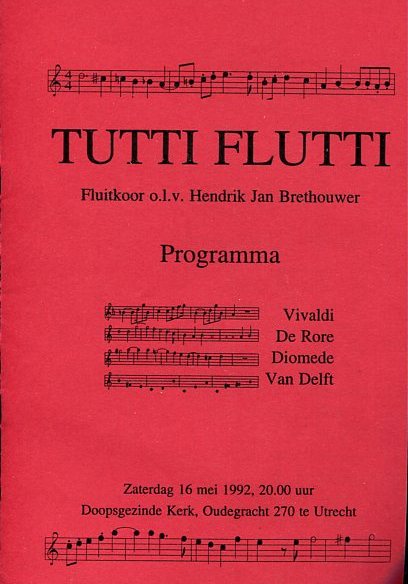
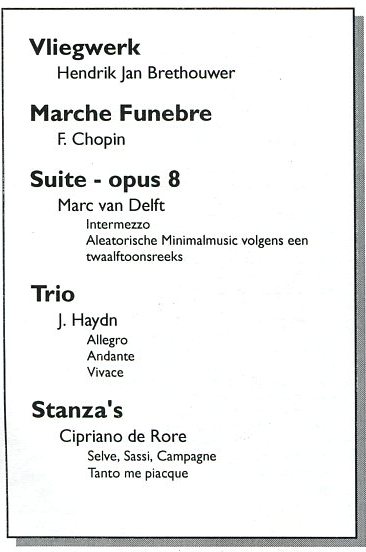
Op 16 mei 1992 speelde Tutti Flutti de laatste 2 delen van de
5:
Intermezzo en het aleatorische minimal-music-stuk.
De componist kon toen wel het concert en een repetitie bijwonen.
On May 16, 1992, Tutti Flutti played the
last 2 parts of the 5:
Intermezzo and the aleatory minimal music piece.
The composer was then able to attend the concert and a rehearsal.
_______________________________________________________
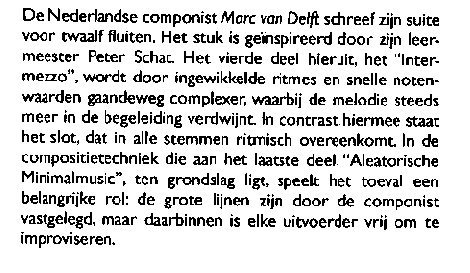
Toelichtingen /
Explanations
In het Intermezzo zie je invloed van het 'Lever du jour' van Ravel [Daphnis
et Chlo?].
In the Intermezzo you see the influence of Ravel's 'Lever du jour' [Daphnis
et Chlo?].
In het aleatorische minimalmusic stuk was het de bedoeling dat het op bv.
Steve Reich zou lijken.
Of dat echt is gelukt is de vraag....
In the aleatoric
minimal music piece the intention was to resemble, for example, Steve Reich.
The question is whether that really succeeded....
---------------------------------------
OPNAMES /
RECORDINGS:
-------------------------------------------